
english patterns
-

Your English already has a personality
…you just don’t know what it is yet. You don’t sound random in English. It might feel like you’re only getting the words out, but if you examine your word choices, there’s a pattern. The way you disagree, the way you give feedback, and the way you turn something down all has a pattern. Let’s…
-
Why “do a mistake” sounds wrong
“I did a mistake.” You understand this sentence immediately. Nothing is confusing, but it still sounds off. “Make a mistake” feels natural. “Do a mistake” doesn’t, even though “make” and “do” are similar and both are grammatically possible. The problem isn’t grammar. This is a collocation: words that naturally go together in a language. Not…
-

Meaning doesn’t live in words
“Coffee?” What does that mean? The answer is: all of them. There’s no subject. No verb. No full sentence. But… it’s completely clear. That’s because meaning doesn’t live inside the word “coffee.” It comes from context: where you are, who you’re with, what just happened, and what both people already understand. Philosophers like Wittgenstein argued…
-
Native speakers break rules constantly
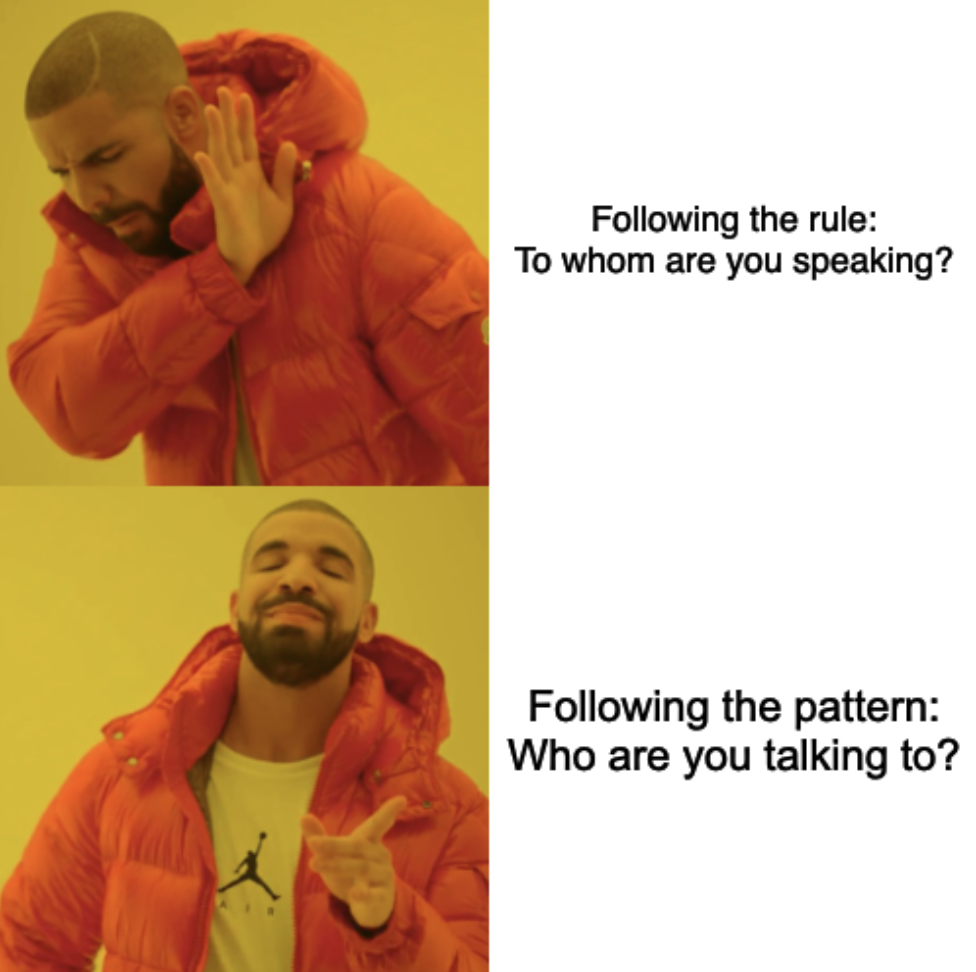
“Who are you talking to?” That sounds completely normal. No one stops mid-conversation to panic about a preposition. Buuuut teeeechnically, you’re not supposed to end a sentence with one. Most people don’t even know that rule. And even the ones who do ignore it constantly. Some rules come from formal grammar teaching, but real English…