
language learning
-

What if you can’t hear something because you don’t have language for it?
For generations, Alaska Native communities described the northern lights as more than something you could see. They also described hearing them crackle, rustle, hiss, even speak. These weren’t isolated stories. Similar accounts appear across Inuit and other Arctic oral traditions, long before scientists took the idea seriously. Scientists dismissed those stories for years. The aurora…
-

The moment “correct” English starts to sound wrong
“I would like to inform you that I have completed the task.” There’s nothing wrong with this sentence. But… no one actually talks like this. This is just what happens when correctness overfires. From a psycholinguistics perspective, language is constantly competing for attention. Your brain prefers sentences that are fast, predictable, and easy to process.…
-

Breaking the rule is the rule (sometimes)
“Me and him went to the meeting.”“Sounds good.”“Gonna send it over.” You’ve been told these are wrong… yet you hear them constantly. In casual speech, meetings, emails, everywhere. Sometimes breaking the rule is a signal.“Me and him…” isn’t careless: it’s casual.“Sounds good” drops structure, but keeps the meaning fast and natural.“Gonna” isn’t incorrect: it signals…
-

Your English already has a personality
…you just don’t know what it is yet. You don’t sound random in English. It might feel like you’re only getting the words out, but if you examine your word choices, there’s a pattern. The way you disagree, the way you give feedback, and the way you turn something down all has a pattern. Let’s…
-

A sentence can be grammatically perfect… and still lose the room
A lot of multilingual professionals focus on using clean grammar, having a solid vocabulary, and figuring out whether a sentence makes sense. But what they say still doesn’t land the way they want. Persuasion isn’t built on correctness. It’s built on how language functions in real time. Aristotle mapped this out a long time ago…
-

Aha!
You don’t learn a word the first time you see it. You might recognize or understand it. But that doesn’t mean you can use it. The shift into usage happens later, when meaning attaches to the word. In Second Language Acquisition, this is called form–meaning mapping, or connecting a word to what it represents. Richard…
-
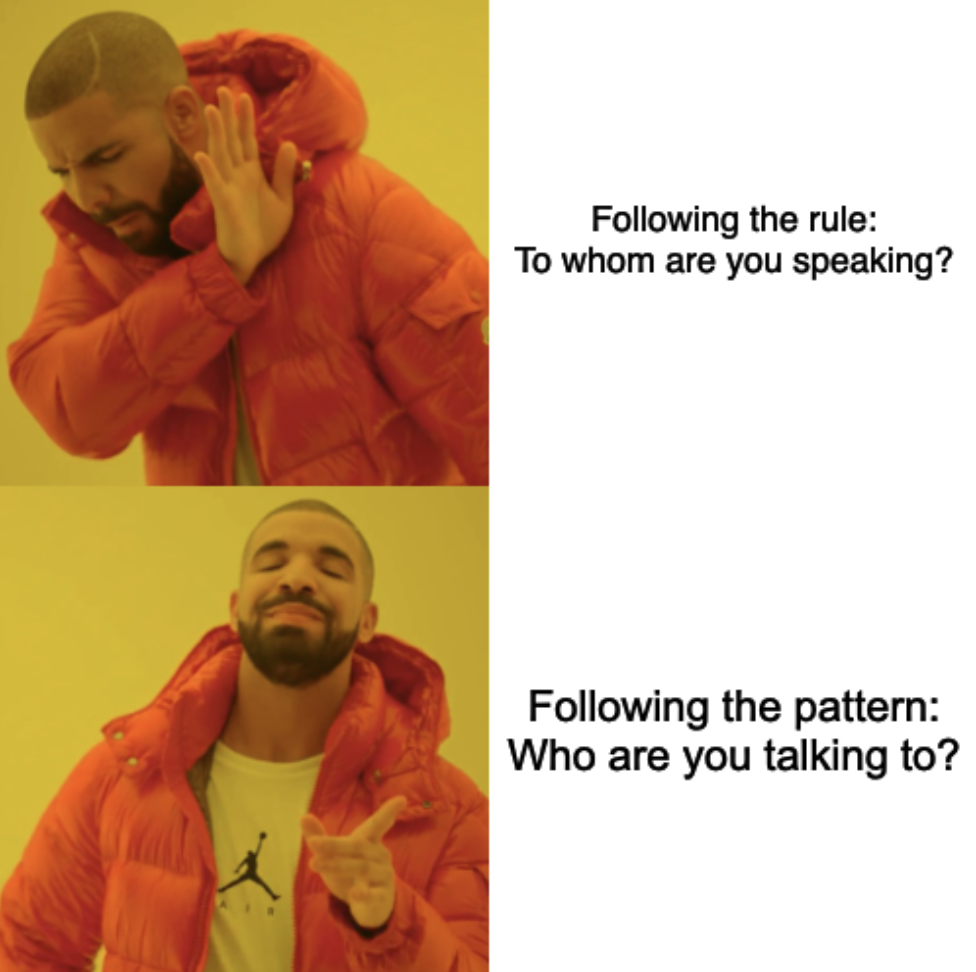
Native speakers break rules constantly
“Who are you talking to?” That sounds completely normal. No one stops mid-conversation to panic about a preposition. Buuuut teeeechnically, you’re not supposed to end a sentence with one. Most people don’t even know that rule. And even the ones who do ignore it constantly. Some rules come from formal grammar teaching, but real English…